

COLORADO CITY, TX — On the Civic Center floor Monday, three AI companies put a $10 million check on the table and told this Mitchell County seat they would help rebuild the water system that failed in July.
Cipher Digital owns and operates the Barber Lake high-performance computing (HPC) data center just outside town. Fluidstack and Anthropic are tenants inside it. Anthropic is the company behind Claude; those models run on the compute in the data center. Google backstops Fluidstack’s lease.
Barber Lake sits in Mitchell County, north of Interstate 20, at 951 County Road 204. It is a county campus that does not connect to the Colorado City water system.
Cipher CEO Tyler Page stood with Kate Franko of Fluidstack, Ryan Wilson of Anthropic, and Cipher’s head of policy and government affairs, Lee Bratcher. City and county officials flanked them: Mayor Ruben Hurt, City Manager Donna Madrid, Precinct 2 Commissioner Jeremy Strain, and Lee Roy Miller, the Republican nominee to succeed Strain in November.
Also in the room was Wrey Montgomery, who heads City National Bank in San Angelo and Colorado City National Bank. The new foundation will bank at Montgomery’s Colorado City bank.
The money opens the Colorado City Water Infrastructure Foundation, a 501(c)(3) funded by Cipher, Fluidstack, and Anthropic. Mayor Hurt said the $10 million is one piece of a $27 million package: the companies’ $10 million, a $10 million USDA grant, and a separate $7 million grant to fix the municipal system.
The city project list includes a new well field, a new water tower, replacement of the 16-inch main that runs about two miles through town, a second line to serve Colorado ISD, and public-safety radios.
Wilson, who came to Anthropic from a similar economic-development role at Amazon Web Services, put the hardware in plain language after the ceremony.
“There’s not much difference between the computers in a data center for AI and a traditional data center from the outside,” he said. “Sure, AI uses more power, but as chip technology continues to improve you’ll see more and more compute power out of a similar footprint.”
He noted that Anthropic developed and maintains Claude. “3.7 million people use Claude in Texas,” Wilson said.
The racks still run hot. That heat is why cooling design matters. In his remarks Monday, Page went further than the press release. Cipher does not tap the Colorado City water system, he said, and it will not. The donation is an indication of Cipher's corporate values, as he framed them, to become part of the towns where the company builds.
“We could see that Colorado City was a community with deep roots,” Page said. The company, he added, is here for the long haul.
The July outage was caused by storm damage at the well-pump station. Power and generators went down, and water pressure gone. This happened on pipes that were already old. “Every gallon of capacity these projects add goes to the city,” the companies wrote.
Anthropic's Wilson framed the data center build-out as geography, not just megawatts.
“The data center buildout is a very large transfer of wealth from the coastal big cities to the American heartland,” he said.
Policy, he argued, has to stay flexible: take the growth, don’t sign away the tax base forever. In Texas, he said, the live fight is likely sales-tax treatment. Right now, Texas law allows the State Comptroller to forgive the state's 6.25% take of the 8.25% sales tax for equipment purchased to operate inside approved data centers.
“Maybe the answer is to offer sales tax forgiveness for 10 years but not forever,” he said, offering an example of the give-and-take to spur data center growth. Governments have to balance opportunity against “making deals that deny the community resources, such as giving away tax abatements indefinitely.” Attracting data center projects will be competitive between states down to local communities.
Incoming Precinct 2 commissioner Lee Roy Miller did not talk like a site-selection consultant. He is a cattleman with decades in the business, and he said the herd never really came back from the 2011 drought. He is running less than half the cattle he ran 20 years ago in the 2000s, he said, because he is still uneasy about water.
He called the data center a necessary economic-development project for the times. Joking, he allowed that data centers might be a sign of the End Times — then promised he would be on the right side when the Second Coming arrived. In the meantime, he said, he was glad the city was getting a huge shot in the arm to fix its water distribution system.
Cipher’s San Angelo project
Cipher's CEO Ryan Page would not announce a start date for Cipher’s Tom Green County campus.
“You won’t see us down there in San Angelo until they (AEP) say we have the interconnection with the grid,” he said. “It’s not that we don’t want to start in San Angelo. It’s that we haven’t received the permission we need yet.”
Cipher wants a 1-gigawatt facility on the northeast side of Tom Green County, about 2,500 feet east of the proposed Emergent/Skybox site — the project the company calls Colchis. At 1,000 megawatts it would be the largest site in Cipher’s footprint: bigger than Barber Lake (300 MW), Black Pearl (300 MW), Stingray (100 MW), or Odessa (207 MW). Cipher would own and run it in the county, outside city limits, the same landlord model as in Mitchell County.
Page’s staff called the Red Creek substation, which sits on the land Cipher acquired, unique. Multiple 345-kilovolt lines cross there. That junction gives Red Creek immense transfer capacity that is rare in Texas, and rarer still next to open land that can take a gigawatt-scale HPC campus. Other Cipher sites grew up around power sources that could feed a few hundred megawatts. Red Creek is why Tom Green County is the one place Cipher can talk about 1 GW. Power, not water, is the gate Page named.
That interconnection is not in hand. Dec. 10 is the day ERCOT has said it will file the governor-ordered Batch Zero eligibility verification and community-impact reports with the Public Utility Commission, for discussion at the PUC’s Dec. 17 open meeting. The Cipher San Angelo project is in Batch Zero, the first proposals to be considered for grid interconnection.
Gov. Greg Abbott’s Aug. 3 audit letter slipped the original August classification date. Conditional Batch Zero labels have already started going out. The actual power allotments — how many megawatts each qualifying large load project can take — are scheduled for April 9, 2027, when ERCOT issues the Batch Zero study report and updated load commissioning plans. A full transmission plan for the batch is expected in fall 2027.
Until AEP and that ERCOT process say yes, Colchis will not be under construction.
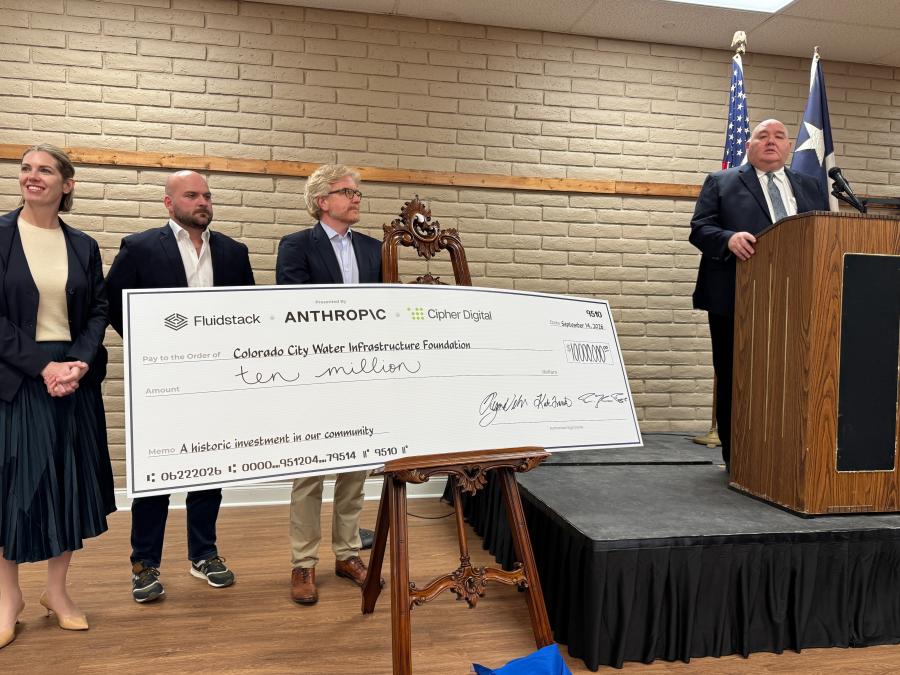
Colorado City Mayor Ruben Hurt is at the podium. To his right, from left to right, are Fluidstack's Kate Franco, Anthropic's Ryan Wilson, and Cipher Digital CEO Tyler Page. (LIVE! Photo/Joe Hyde)

Subscribe to the LIVE! Daily

Required
Post a comment to this article here: