

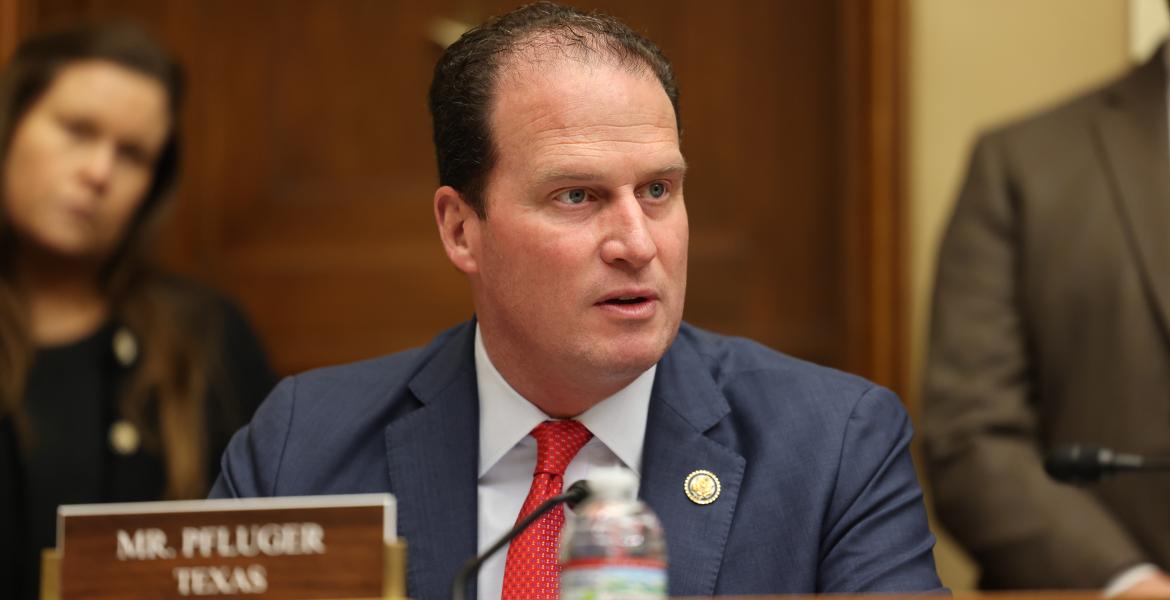
WASHINGTON, D.C. — Today, Congressman August Pfluger (TX-11) voted to pass the Farm, Food, and National Security Act of 2026, commonly known as the Farm Bill. Rep. Pfluger secured major wins in this year's bill, delivering for both Texas's 11th Congressional District and America's broader agriculture community.
The Farm Bill is one of the most consequential pieces of legislation that shapes food, agriculture, and rural life in the United States. The legislation is set to be renewed roughly every five years, yet Congress has not passed a Farm Bill since 2018, making this year's bill especially important. Texas-11 is one of the most abundant suppliers of agricultural resources in America, and Rep. Pfluger has been a longtime advocate for farmers and ranchers in Washington.
To applaud its passage, Rep. Pfluger released the following statement:
"For too long, Texas farmers and ranchers have been pushed to the brink, battling rising costs, workforce shortages, and relentless weather uncertainty. Now, we are one step closer to getting our farmers the certainty they need. This Farm Bill is a major victory for the West Texas agriculture community, which is the backbone of our nation's economy and a critical pillar of our national security. It delivers tangible, agriculture-focused solutions and locks in several key provisions I was proud to fight for. With fewer than 2% of Americans working to feed, clothe, and fuel the entire country, passing this legislation out of the House was essential. After nearly a decade of delay, House Republicans stepped up and took action."
The bill includes several of Rep. Pfluger's top agriculture priorities that he fought to secure, including:
- Streamline Disaster Assistance Programs (Sec. 1004): specialty crop emergency framework. (Sec. 1003): TAP advance payments with 120-day deadlines, improved ECP/EWP.
- Robust EQIP Funding with Streamlined Applications: adds precision ag at 90% cost-share, $200K payment limits, streamlined TSP program with clear timelines.
- Groundwater Sustainability & Drought Relief: EQIP water conservation practices, national flood vulnerability study, Drought Monitor reauthorization, zero/low-interest loans for distressed water systems, High Plains crop insurance pilot.
- Extend Feral Swine Eradication Program (Sec. 2402): makes the program permanent at $150M for FY2025–2031 (40% NRCS / 60% APHIS). Requires land-grant university contracts.
Several of Rep. Pfluger's submitted Farm Bill provisions were achieved last year in the Working Families Tax Cuts, including:
- Increase ARC/PLC Reference Prices for Seed Cotton: H.R. 1 delivered reference price increases of 10–20% beginning with crop year 2025, including for seed cotton, the first meaningful Title I investment since 2002.
- Add Base Acres / Historic Acre Basis for Title I: H.R. 1 added 30 million new base acres, so all row crop producers have access to Title I programs.
- Maintain Pima Cotton & Wool Trust Funds: H.R. 1 funded the Wool Trust Fund, Pima Cotton Trust Fund, and citrus greening programs as orphan programs.
- WOLF Act: A core provision of the WOLF Act was signed into law in H.R.1 (Sec. 10401), increasing livestock indemnity from 75% to 100% of market value when killed by federally protected species. Black Vulture and Caracara take authorities were not included, and may need a separate vehicle.
- $6B crop insurance investments: Made higher levels of coverage more affordable through increased premium support and enhancements to area-wide plans included in H.R. 1.
The bill also includes several provisions of particular importance to TX-11 and Texas:
- Crop Insurance Late-Planting Pilot (Sec. 11011): A pilot in at least 10 counties in or adjacent to the High Plains Groundwater Conservation District in Texas to evaluate the late-planting coverage penalty for corn — directly addressing West Texas producer concerns.
- Southern Border Initiative (Sec. 2202): Authorizes one-year contracts for repair of damages accruing on the southern border, supporting ranchers in the TX-11 border region.
- Cattle Fever Tick Eradication Review (Sec. 12002): Directs a university review of the program, critical for Texas cattle producers near the quarantine zone.
- New World Screwworm Preparedness (Sec. 12001): With NWS at our doorstep, the bill clarifies that animal disease traceability is an eligible activity under the National Animal Disease Preparedness and Response Program (NADPRP) and extends all program authorizations. Combined with H.R. 1’s $1.5 billion investment in livestock biosecurity (supporting APHIS, USDA labs, and vaccine development), these provisions strengthen the infrastructure needed to detect and respond to an NWS incursion along the southern border — a top concern for TX-11 cattle producers.
- Texas Water Treaty Report (Sec. 12408): Requires USDA to report on all authorities available to assist Texas producers harmed by Mexico’s failure to deliver treaty-obligated water.
- Save Our Bacon / Prop 12 Fix (Sec. 12006): Establishes a federal right to raise and market livestock in interstate commerce, preventing California and other states from imposing extraterritorial production mandates on Texas livestock producers. Protects small and mid-sized operations from the $4,500+/sow compliance costs that have already forced 12% of small pork operations out of the market.
- Livestock Market Structure / A-PLUS Act (Sec. 12111): Amends 9 CFR 201.67 to allow livestock auction owners to invest in, finance, or manage packing facilities with capacity under 2,000 head/day for cattle and sheep. Requires disclosure and preserves Packers & Stockyards enforcement. Designed to expand independent processing capacity closer to producers in cattle country, directly benefiting TX-11.
- Precision Agriculture: Comprehensive provisions across Titles II, V, VI, and VII promote precision ag adoption through EQIP cost-share (90%), conservation loan priorities, rural entity financing, and research grants — benefiting large-scale cotton, sorghum, wheat, and cattle operations in TX-11.
- Enhanced Commodity Safety Net: H.R. 1’s reference price increases (10–20%), additional base acres, and crop insurance premium support directly benefit the cotton, grain sorghum, wheat, and cattle operations predominant in the district.
- Feral Swine Eradication: Now a permanent program at $150M — West Texas has among the highest feral hog densities in the nation.
- Rural Broadband & Water: The ReConnect program ($350M/year), rural water infrastructure investments, and precision ag connectivity standards address critical needs across the district.
- Wildfire & Rangeland: Expanded categorical exclusions (10,000 acres), mandatory 24-hour suppression, grazing-as-wildfire-strategy, and rangeland research initiatives benefit fire-prone and rangeland-dependent areas.
Subscribe to the LIVE! Daily
Required
Post a comment to this article here: