

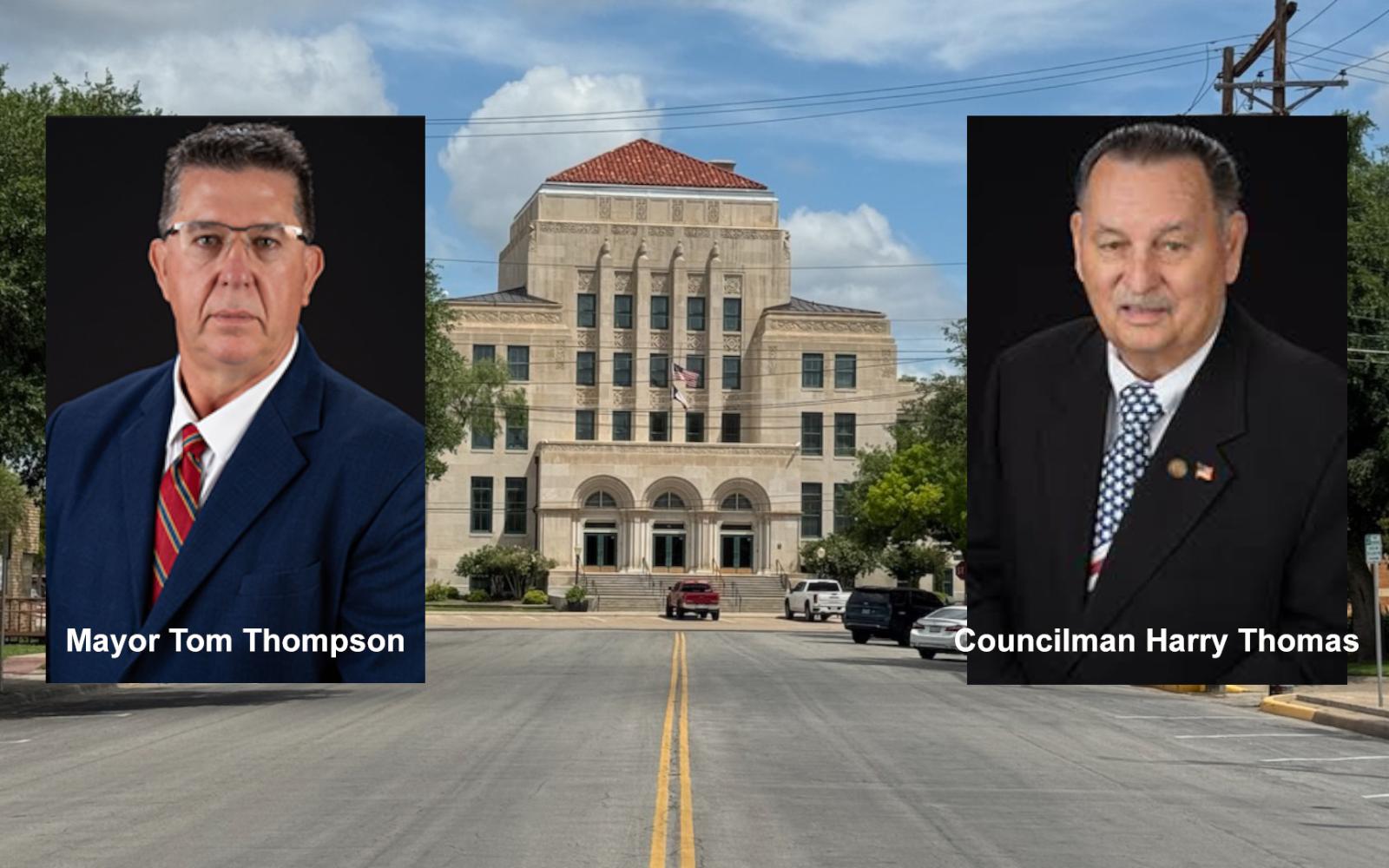
SAN ANGELO, TX — San Angelo taxpayers could face bills of up to $150,000 or more if active recall petitions against Mayor Tom Thompson and Councilman Harry Thomas force special elections.
According to the San Angelo City Clerk’s office, each election is estimated to cost between $30,000 and $60,000, depending on whether the Tom Green County Elections Office can combine the recall questions with other scheduled voting dates. Because recalls typically require two elections per official — one on whether to remove the officeholder and a second to select a replacement — the combined cost for both petitions could reach or exceed $150,000. In Councilman Thomas’s case, the total could be higher because a successful recall could trigger three elections.
Signature Thresholds and Deadlines
The two petitions carry different requirements under the City Charter.
For Mayor Tom Thompson, petitioners must collect 2,971 signatures — 30% of the votes cast in the May 2025 mayoral election. The deadline is June 22, 2026.
For Councilman Harry Thomas in Single Member District 3, only 47 signatures are needed because just 155 votes were cast in his last election. Those signatures must come from registered voters living within District 3. His deadline is July 28, 2026. Thomas is in his final term, which will mark 10 years on the council. City legal staff is still reviewing whether a successful recall would require a separate replacement election or if the seat could remain vacant until the regular May 2027 city election. Or, the council could appoint a replacement and if that replacement was Harry Thomas, it will reset his term limits counter allowing Thomas to serve another eight years.
Suspicions About the Coalition and Its Coordinator
The San Angelo Data Center Citizen Coalition is leading both recall efforts. In a recent email exchange, coordinator Richard Summers described the group as an informal, volunteer-led collection of local residents focused on public process and transparency rather than opposition to the data center project itself.
“The recall is not about the data center itself,” Summers wrote. “It’s about the Mayor’s role in how information has been communicated and how public process has been handled in matters of significant community impact.”
He stated that the coalition is not currently organized as a 501(c)(4) or any formal entity and has made no Texas Ethics Commission filings. Participation is open and fluid, and the group is currently focused on conducting the recall process according to the City Charter.
Local Political Culture and Questions About Summers
San Angelo has a long-standing political and cultural divide between longtime “born here” residents and those who arrived later in life. Historically, people born and raised in San Angelo have held an advantage in winning elections and shaping political movements.
Against that backdrop, some residents have expressed surprise at how quickly a recent transplant has organized and led a recall effort against two popular sitting public officials, potentially costing taxpayers six figures or more.
A digital copy of a 2011 certificate of ordination circulating on Facebook shows that Richard Summers was ordained a priest in the Reformed Celtic Church. The only information about that church can be found on the Wayback Machine as its website no longer is up. That church, which describes itself as Celtic in spirituality rather than ethnicity, emphasizes “equality, simplicity, justice, compassion and peace” and draws on early Celtic theologians. This suggests a more progressive or socially engaged theological posture than many traditional dispensational or fundamentalist groups.
Questions have circulated about Summers’ background, including prior residences associated with New York and a 512 area code linked to Austin, as well as his work as a voice actor. Some citizens have speculated that he was brought to San Angelo specifically to organize opposition to the data center and foment distrust in local government.
Recent reports from the Bitcoin Policy Institute and congressional investigations have identified a network of U.S. nonprofits funded by Neville Roy Singham, a former American tech executive now living in Shanghai, that have actively opposed data center and AI infrastructure development across the United States. Organizations frequently mentioned in these reports, including CodePink and the Tricontinental Institute for Social Research, have framed data centers as environmentally harmful and tied to corporate and military power — messaging that echoes themes promoted by Chinese state media. Analysts argue that slowing U.S. data center construction serves Beijing’s broader strategic interest in delaying American advances in artificial intelligence.
No direct evidence has surfaced linking these national networks directly to the San Angelo Data Center Citizen Coalition or to Summers other than rhetoric. At a forum hosted by the city several weeks ago, a speaker from the coalition stated his opposition to using a San Angelo-based data center for U.S. military applications.
A separate national network, the Halt the Harm Network, operates the website datacenters.halttheharm.net, which has become a widely shared resource for anti-data center activism. Originally focused on opposing oil and gas development, the network has expanded into data center opposition and explicitly frames the issue as “the new fracking.” The site provides local campaigns with strategic tools, including the “Seven Gateways Framework,” training sessions on building a national movement against AI data centers, and rapid-response support for grassroots organizers. It collaborates with groups such as FracTracker Alliance and has hosted webinars with Food & Water Watch.
San Angelo pastor Abel Arias posted on Facebook questioning Summers’ clerical credentials and motivations, writing that he had “never heard of Summers as a ‘voice actor’ or ‘priest’” and suggesting he may be playing a role “to whip up fear against computer centers in San Angelo.” Arias also raised questions about transparency regarding other individuals he believes are involved in the coalition.
Summers has responded to direct questions about the group’s structure by confirming it is currently informal and volunteer-based, with any future formal organization to be addressed as the effort develops.
Targeted City Leaders Defend Their Actions
Both Mayor Tom Thompson and Councilman Harry Thomas have defended the city’s pursuit of major commercial and industrial projects as a necessary response to long-term fiscal pressures.
Mayor Thompson said the coalition “does not have many facts on its side,” but that the city has nevertheless addressed its concerns by regulating data center water use, sound and lighting.
“We have done everything the coalition has asked of us,” he said. “Today, regardless of whether you are for or against data centers, and when Skybox or if any other data center comes to San Angelo, we now have rules all have to abide by.”
Thompson noted that economic development has been the dominant issue in every campaign he has run. He described the Emergent/Skybox project as the type of large-scale investment needed to ease property tax pressure on residents and small businesses.
“If the value of this data center is $7.2 billion, at the current city tax rate of $0.7947 per $100 of valuation, the property tax revenue it provides us is equivalent to adding 80,000 to 90,000 more homes inside the city limits,” Thompson said. “Would you rather have 90,000 more homes here or a box in the middle of a pasture that no one will see or hear that pays the same amount of property taxes as 90,000 more homes?” (There are about 50,000 water meters in San Angelo and 90,000 more homes is nearly a 2x increase).
He pointed to more than $1 billion in identified capital improvement needs for the city, including $400 million for water infrastructure and tens of millions for public safety facilities.
“When you look at all of these demands, the question is, how do you pay for all of that?” Thompson asked. “No one has provided any other ideas as to how to pay for any of this. We can get that revenue from a commercial or industrial development or drastically raise taxes on our citizens. I didn’t run for mayor to raise taxes.”
Councilman Harry Thomas made a similar argument, noting that state restrictions on property tax increases have made it increasingly difficult to fund city services — especially policing and fire protection — without growing the sales and property tax base through new business investment. He highlighted that server purchases at a data center would generate significant additional sales tax revenue on top of the property tax gains.
City Has Already Enacted Regulations
On May 19, 2026, the City Council approved specific land-use regulations for data centers, along with ordinances governing wastewater discharge and water-use standards. Tom Green County commissioners also declined this week to impose a moratorium on similar projects.
The coalition has raised concerns about transparency and the handling of high-impact decisions. The developer has stated the project would use closed-loop cooling with limited ongoing water use after an initial fill.
The Cost of the Recall Process
Whether the petitions reach their required signatures by the June and July deadlines will determine if San Angelo holds additional elections. If they do, taxpayers will bear the estimated costs regardless of how any individual feels about the data center or the officials facing recall.
Recalls remain a legal mechanism under the City Charter. The low signature threshold for Councilman Thomas’s petition means a small number of residents can trigger a process that may cost the public six figures.
At the same time, Summers has framed the recall effort around government transparency. On the other hand, critics have questioned whether the coalition itself has been transparent about its leadership, structure and motivations.

Subscribe to the LIVE! Daily
Required
Post a comment to this article here: