

SAN ANGELO, TX — A proposed data center campus in west Tom Green County near the Dove Creek area has filed an air permit application with the Texas Commission on Environmental Quality (TCEQ) that outlines expected emissions from on-site natural gas power generation. The filing, submitted by Westline TX Holdings LLC and linked to Beacon Data Centers, seeks authorization for a facility 0.25 miles south of US 67 on FM 2335 that would use banks of reciprocating natural-gas engines to supply electricity.
The public plain-language summary of the application lists several major pollutants the engines are projected to release each year under maximum permitted conditions. Local residents and officials have focused particular attention on three of those numbers: 1,177.2 tons of carbon monoxide (CO), 419.3 tons of nitrogen oxides (NOx), and 117.2 tons of sulfur dioxide (SO₂).
What the Numbers Mean in Everyday Terms:
Carbon monoxide – 1,177.2 tons per year
Carbon monoxide is the colorless, odorless gas produced by incomplete combustion. One way to picture the volume is to compare it with vehicles. A typical passenger car produces roughly 200–250 pounds of CO in a year of normal driving. At that rate, 1,177 tons is roughly equivalent to the annual carbon monoxide output of 9,000 to 12,000 cars. Modern engine controls and oxidation catalysts are designed to keep the actual release far below the permitted maximum.
Nitrogen oxides – 419.3 tons per year
NOx contributes to ground-level ozone and fine-particle pollution. An average modern gasoline car emits only about 15–20 pounds of NOx annually. Using that benchmark, 419 tons equals the yearly NOx from roughly 40,000 to 55,000 passenger vehicles. Heavy diesel trucks emit far more per mile, so the same total could also represent the annual output of a few thousand trucks operating in stop-and-go conditions. The application states the engines will use selective catalytic reduction (SCR) systems, the same technology employed at many modern gas power plants to cut NOx.
Sulfur dioxide – 117.2 tons per year
SO₂ is the sharp-smelling gas associated with burning sulfur-bearing fuels. Because the Westline engines are planned to run primarily on pipeline-quality natural gas (which contains very little sulfur) and ultra-low-sulfur diesel for emergency units, the projected SO₂ total is relatively modest. It is still equal to the weight of about 20–25 fully loaded dump trucks. For comparison, older uncontrolled coal plants of similar generating capacity once released thousands of tons of SO₂ annually.
Some local discussion has included claims of 200-foot smokestacks. That height is typical of large coal-fired or combined-cycle gas turbine plants that handle massive volumes of hot exhaust. The Beacon/Westline proposal uses modular reciprocating engines rather than a handful of giant turbines. Industry experience with similar natural-gas engine plants shows exhaust stacks commonly range from 50 to 75 feet, occasionally reaching 80–100 feet when air-dispersion modeling or local terrain requires greater height for compliance with federal air-quality standards.
So when people talk about exhaust stacks in the 50–80 foot range for a facility like the proposed Beacon/Westline plant, picture something about as tall as a 5- to 7-story building, not a skyscraper and nowhere near the 15–20+ story height of a classic 200-foot industrial smokestack.
Good Engineering Practice guidelines and past permitting of comparable RICE facilities indicate that stacks in the 50- to 80-foot range are usually sufficient to disperse the exhaust and meet National Ambient Air Quality Standards. The public summary of the TCEQ application does not list final stack heights; those details appear only in the full technical package and are subject to revision during the agency’s review.
The project is still in the permitting stage. The engines would be equipped with both SCR for NOx control and oxidation catalysts for carbon monoxide and organic compounds. TCEQ will evaluate the application against state and federal emission limits, conduct air-dispersion modeling, and open a formal public comment period once the technical review is complete.
The final permitted emission rates and exact stack heights will be set only after the review process concludes.
Two hours after this story was published, State Rep. Drew Darby responded, demanding a public hearing at the TCEQ over the Beacon data center permit.
Below is only a representative image of a power generation plant to illustrate what 50- to 80-foot high smokestacks could look like. It is not official or part of the TCEQ permit application:
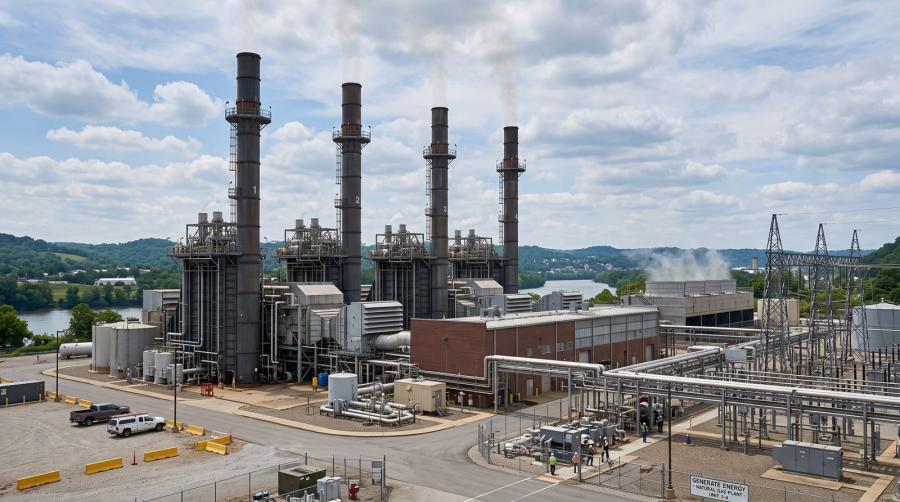
Smoke stacks at a power plant, representative image. Shown to display what 50- to 80-foot smokestacks will look like.


Subscribe to the LIVE! Daily

Required
Comments
Listed By: Old Buffalo Hunter
Reading the Permit Filing you Find:
West Line is using Bergner 20 Cylinder Natural Gas Powered Engines and a lot of them, 240 to be exact. Exhaust Stacks 180' Tall (Higher than the Cactus Hotel.) The generators attached to these engines with engine blocks over fifty feet long, will put out an electrical power field large enough to power Miami, FL. The heat island is immense and will raise the ambient air temperature 16 Degrees above the summer time average. The pollutants will fall as far as Grape Creek with the largest polluted area being Buffalo Heights. Highland Range Estates and The Bluffs will get their share along with South Western San Angelo. with summer prevailing winds. My, my, head in the sand. It's the power plant Vern.
- Log in or register to post comments
PermalinkListed By: Old Buffalo Hunter
This was Breaking News 29 Days Ago. Joe's Smoke and Mirrors at work.
- Log in or register to post comments
PermalinkListed By: Rita Repulsa
Folks, recent psychological studies decisively demonstrate that the only reason anyone opposes data centers is due to being a repressed homosexual. Get therapy. (The kind that turns you gay, not the kind that cures it.)
- Log in or register to post comments
PermalinkPost a comment to this article here: